Big picture - what’s your strategy?
Great pasture takes more than day to day decisions. Yes, these are always important. But they must align with your high level farm system strategies so you (and your animals) get the best from your pasture.
First principles
Underlying everything is the need to match feed demand (animal requirements) with feed supply (pasture and crops). Pasture is the cornerstone of this very dynamic relationship. But you need other levers to pull, to complement pasture growth, and create the right feed balance for your system, year-round.
What’s your demand
This is the easier side of the formula. You can predict how much feed you need in the season ahead, with reasonable accuracy.
What class(es) of animal you run, what breed(s) you prefer, your stocking rate, calving and lambing dates – these all create seasonal feed demand on your farm. Animal
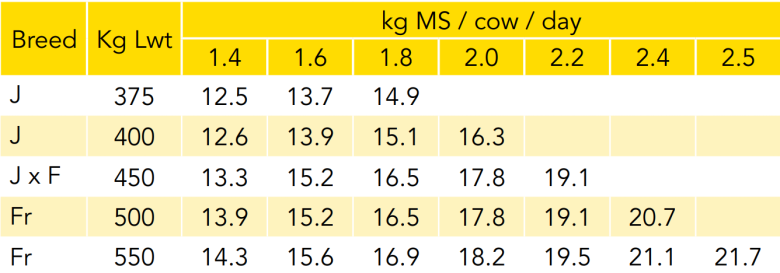
feed requirements are well documented, such as these for milking cows:
Daily milking cow feed requirements: kg DM/cow/day at 12.0 MJ ME/kg DM
What’s your supply?
Feed supply, on the other hand, can and does change suddenly! Feed deficits are much more common and disruptive than feed surpluses, so every farm will need contingencies to offset this risk. Among the most useful are:
Summer crops
To secure home-grown summer feed when hot, dry weather depresses pasture growth and quality. These keep your animals better-fed over summer, but that’s not all. They support good pasture management, because:
- You can pull paddocks out of rotation to sow crops in times of surplus spring growth, which helps control grazing and thus pasture quality across the rest of the farm.
- You can also reduce the risk of over-grazing pastures in summer, which compromises persistence.
Winter crops
To carry a large bulk of feed into winter when grass slows down. Pasture might reach around 4 t DM/ha maximum at this time of year, but rape might be 8 t DM/ha, kale 15 t DM/ha and fodder beet over 20 t DM/ha.
Silage/hay
For extra feed during deficits. Harvest these from surplus pasture, and you maintain high quality grass at the same time. Silage and hay have two big benefits compared to crops – you can store and use them as needed; and you always know how much you have on hand.
Imported supplements
Include PKE, grain, baleage or hay. Typically your most expensive option, but can be very helpful in severe feed deficits.
How flexible are you?
Flexible farm systems help you balance the feed demand side of the equation in erratic weather, particularly dry summers. Key strategies include:
Trading stock
Having many animals that can be bought or sold at any time in response to the weather is a real strength for many farmers. Quitting trading stock heading into a dry summer to ease feed demand is a common example.
Farm to the season, not the calendar
For a sheep farmer, this could mean early weaning, or selling lambs store instead of finishing them. For a dairy farmer, examples include OAD milking, selling culls or drying off cows early.
Nitrogen boost
Nitrogen fertiliser can provide an economic boost in pasture growth when needed.
Management
For more on managing drought, see Preparing for dry summers, or Responding to flood for more on recovering from flood.