Brassica crop rotations
Brassicas are often best used in a two-crop sequence to give better year-round feed supply.
This also improves subsequent pasture renewal, through better weed control and paddock preparation.
Advantages of a prior crop
Often paddocks are chosen for brassicas because of poor pasture growth. This may be due to underlying problems like poor soil fertility, drainage, weeds, pests or diseases. A prior crop (e.g. annual ryegrass) allows you to correct any issues before sowing the brassica, helping ensure high crop yields. It also provides valuable cool season feed.
Where weed content is high, multiple crops and herbicide applications achieve much better long-term weed control. And with turfy, fibrous grass weeds like browntop or cocksfoot, a prior crop gives time for turf to break down so you get a better seedbed for brassicas.
Crop rotation examples
Kale or swedes
Annual ryegrass can be sown before a winter kale or swede crop to produce extra winter and early spring feed.

Summer turnips
Annual ryegrass can be sown before a summer turnip crop to give you extra winter and early spring feed.

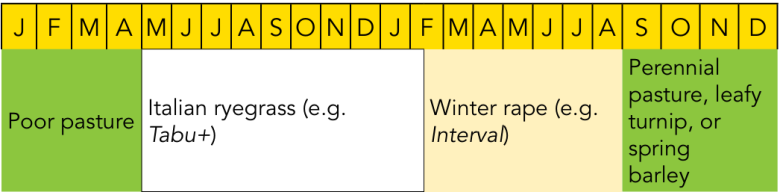
Winter rape
A winter rape crop could be sown after Italian ryegrass, followed by one or several spring sown crops.