
Building pasture cover for lambing
The amount of pasture available in early spring influences the whole production cycle for the year ahead. Success lies in planning ahead, using three tactical reference points: the August target, the May target, and January/February/March decisions.
Key feed planning decisions
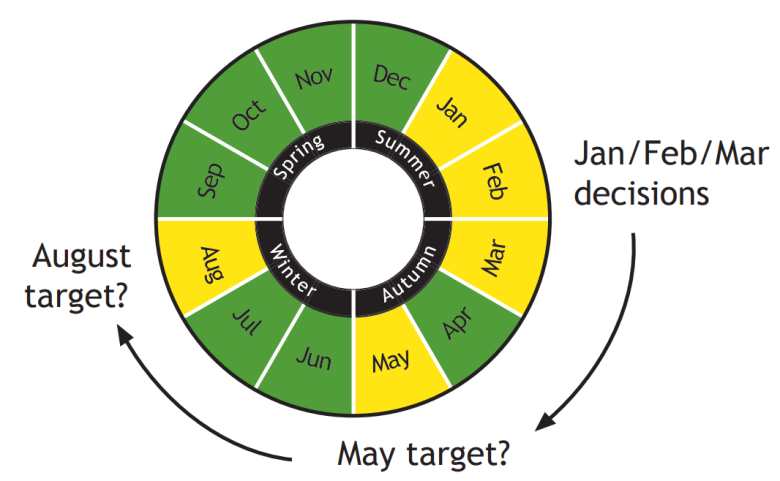
- A winter feed budget will determine the cover needed at the start of winter to achieve the August target. This is the May target.
- Identify how much pasture cover is required at lambing. This is the August target. The typical minimum for set stocked single-lamb bearing ewes is 1200-1300 kg DM/ha (3-4 cm pasture height) or 1500-1600 kg DM/ha (4-5 cm height) for twin-bearing ewes. Tyson perennial ryegrass can increase early growth.
- Decisions need to be made as to what to do in autumn to achieve the May target. These are the January/February/March decisions.
Four potential scenarios
- The autumn stock selling policy affects the May target. Avoid holding onto animals too long. Without supplementation post-lambing, the cost will always be counted in ewe condition post-weaning, and thus conception the following year.
- An autumn drought halts growth. Hold animals on a sacrifice block, and feed supplements. This should be continued even after it rains to allow the farm cover to build up. New growth should not be grazed as it emerges because it is critical to pasture recovery. (See preparing for dry summers).
- Ewes are overfed during winter, and the August target is hit in July. Avoid this situation by rationing feed. Overfeeding ewes when they should be on maintenance leads to potential birthing difficulties and underfeeding post lambing.
- Pasture growth fails to meet the budge. Use N tactically in autumn and/or spring. Soil temperatures must be above 8°C (preferably above 10°C). Using nitrogen to reach target covers at or immediately post lambing has proved highly cost effective, especially with high fecundity ewes.
Pasture choices
Sowing different pastures can improve lambing covers in two ways. Cultivars with extra autumn growth (e.g. Shogun or Forge hybrid ryegrass, or Maxsyn perennial ryegrass) can help build May covers. Cultivars with extra early spring growth (e.g. Tyson perennial ryegrass) can feed animals better through lambing.